
提示词
2x2 grid, Do this for 4 everyday objects <input> $ input = [everyday object, furniture, wearable, product, tech device, vehicle] </input> <instructions> Act as a kinetic architect, deployable systems engineer, and spatial product designer. Transform $ input into a transformable concept inspired by adaptive structures. Infer: $ motion_logic = origami folding, scissor linkage, tensegrity, sliding rail, or pneumatic deployment | $ structural_paradigm = load-sharing, compact stowage, rapid assembly, or variable geometry | $ hinge_joint_system = living hinge, ball detent, magnetic latch, or carbon pivot | $ title = bold kinetic concept name. Create a technical design board. 01 ENVIRONMENT (Top-Left): Visual studies of $ motion_logic: architectural deployments, folding sequences, spatial constraints, reference mechanisms. 02 SYSTEMS (Top-Right): Diagram $ structural_paradigm: force distribution, lock positions, travel paths, redundancy, and user actuation points. 03 TRANSLATION (Bottom-Left): $ input in multiple states: stowed, deploying, locked, and in-use. Include interface studies and safety interlocks. 04 BUILD (Bottom-Right): Joint details, wear surfaces, damping materials, fastening logic, and maintenance access panels. Hero Render: Photorealistic $ input mid-transformation. Elegant, engineered, desirable, spatially intelligent. Style: Architectural digest meets engineering patent sheet, crisp shadows, clean backgrounds, geometric annotations, 8k realism. Negative: No impossible physics, no messy cables, no cartoon hinges, no watermark, no cluttered composition, no fantasy architecture. </instructions>
中文版
相关推荐

2x2 grid, Do this for 4 everyday objects <input> $ input = [everyday object, fur

Place the primary chassis or structural platform perfectly centered as the core

2x2 grid, Do this for 4 everyday objects <input> $ input = [everyday object, fur
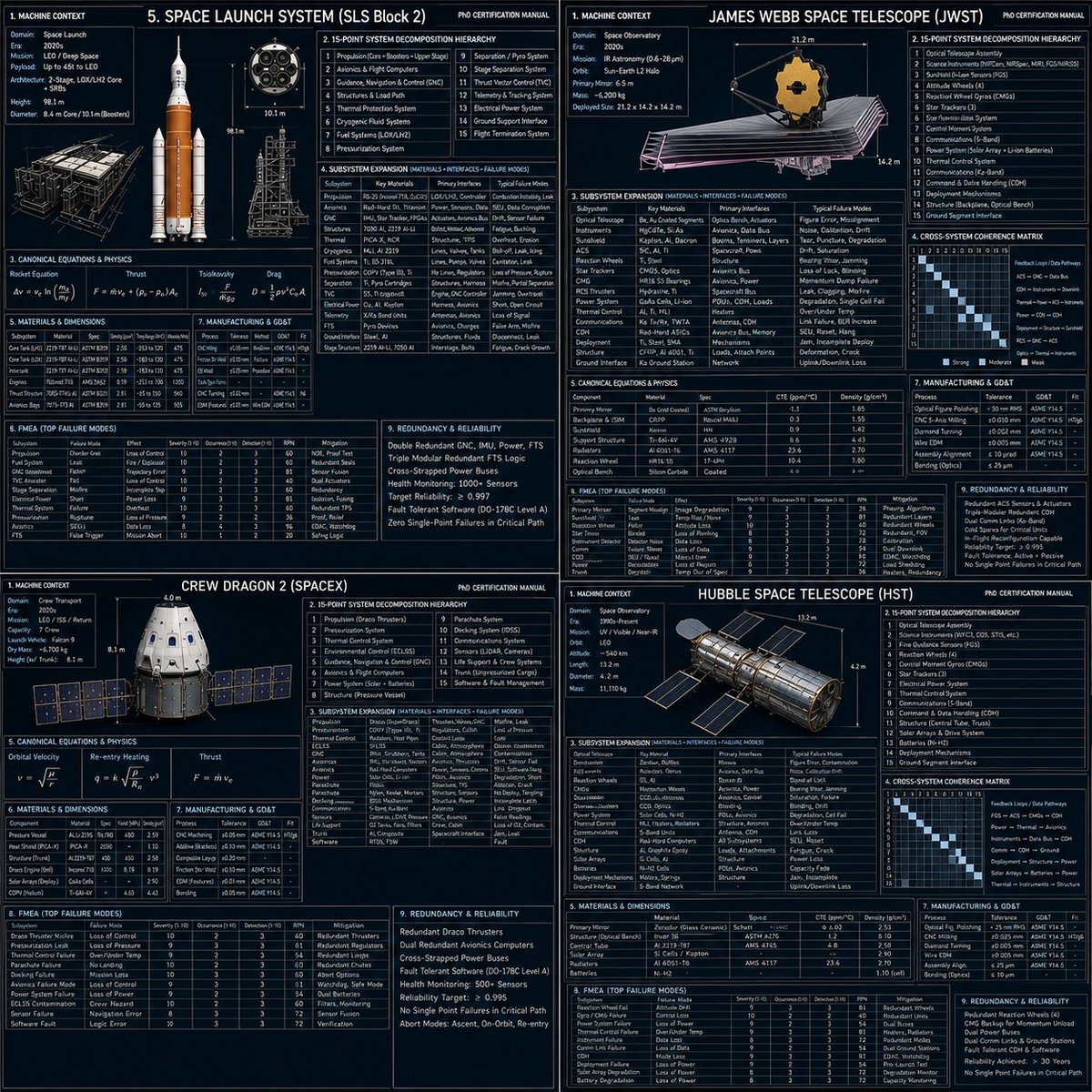
2x2 grid, 1080x1080, do this for 4 complex space machines: System Role: You are